
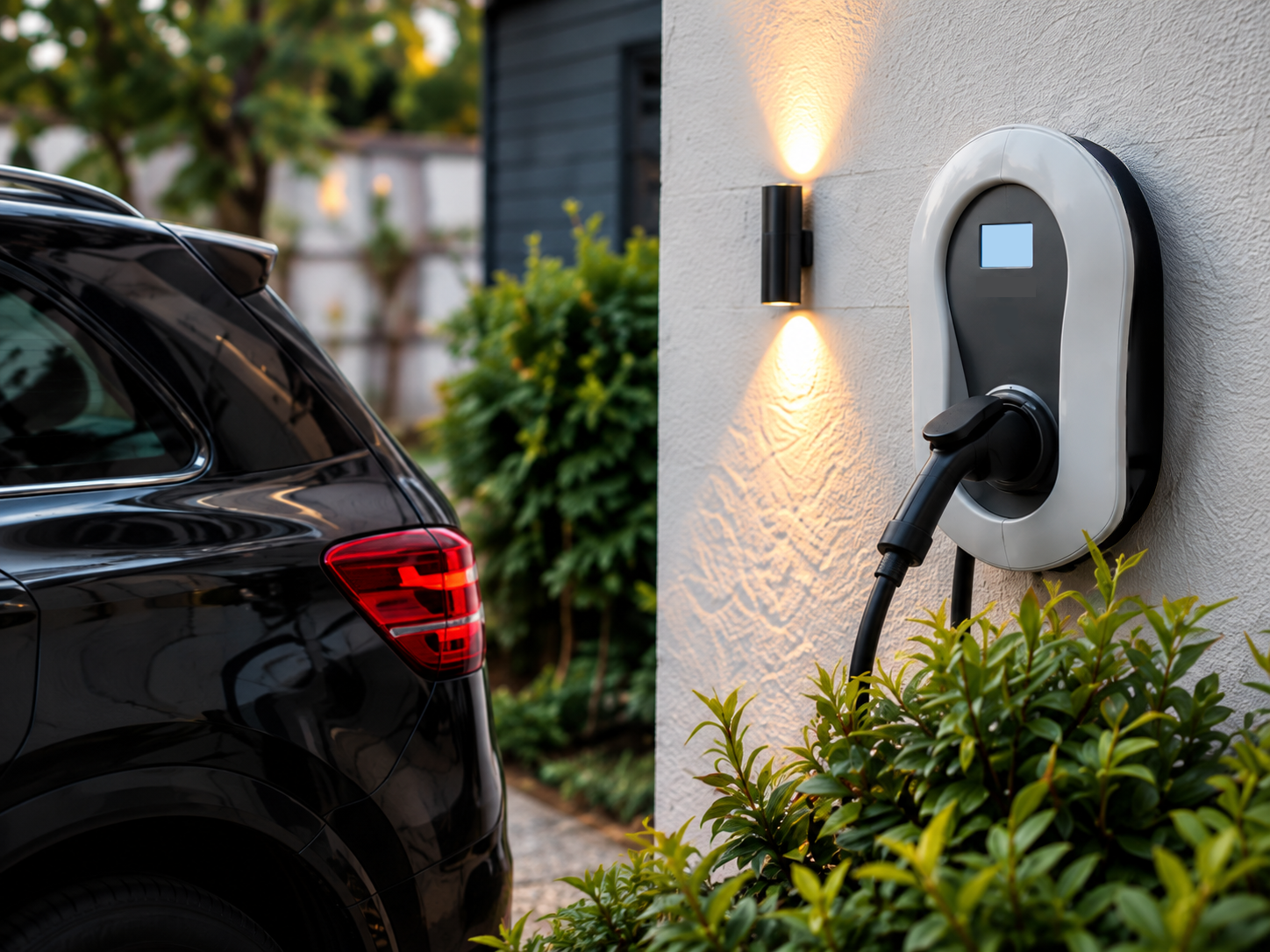
Electric vehicles are becoming an increasingly common sight on UK roads, and for most EV owners, being able to charge at home is one of the biggest advantages of making the switch.
A dedicated home EV charger allows you to plug your car in when you arrive home and have it ready for the next journey, without relying entirely on public charging stations.
But which charger should you choose? How powerful does it need to be? Will your existing electrical supply cope? And what actually happens during an EV charger installation?
In this guide, J2B Electrical explains everything you need to know about installing an EV charger at home.
J2B Electrical provides professional home EV charger installation throughout Fareham, Southampton, Portsmouth, Whiteley, Park Gate, Warsash, Wickham, Waterlooville and the surrounding Hampshire area.
What is a home EV charger?
A home EV charger is a dedicated charging point installed at your property specifically for charging an electric or plug in hybrid vehicle.
Although some vehicles can technically be charged from a standard domestic socket, a dedicated EV charger provides a much more practical solution for regular home charging.
A professionally installed charger is designed to safely deliver sustained power to your vehicle and can offer features such as scheduled charging, mobile app control, charging statistics and integration with suitable energy tariffs.
Modern domestic EV chargers are also smart chargers.
Chargepoints sold for domestic use in Great Britain are generally required to provide smart functionality, which allows charging times and power consumption to be managed electronically. Legislation.gov.uk
How fast can you charge an electric car at home?
For most UK homes, a 7kW EV charger is the standard choice.
The exact amount of charge added each hour depends on the vehicle, battery and charger, but a 7kW unit will normally provide considerably faster charging than relying on a standard domestic socket.
For many drivers, this means the vehicle can simply be plugged in overnight and be ready again the following morning.
Some properties may be capable of supporting faster charging, but this depends on the electrical supply available at the property and whether the vehicle itself can accept the additional power.
A qualified installer should assess this before recommending a charger.
Do I need a 7kW or 22kW EV charger?
You may see both 7kW and 22kW chargers advertised, but bigger does not automatically mean better.
Most residential properties have a single phase electricity supply, which normally makes a 7kW charger the most appropriate option.
A 22kW charger generally requires a suitable three phase electrical supply. Even where three phase power is available, the vehicle also needs to support the higher AC charging rate before you will benefit from it.
For the majority of domestic EV owners, a professionally installed 7kW charger provides an excellent balance between charging speed, practicality and installation requirements.
Can any house have an EV charger installed?
Many homes can accommodate an EV charger, but every property is different.
Before installation, the electrical supply and proposed charger location should be assessed.
The installer will consider factors including the existing electrical installation, available electrical capacity, consumer unit, earthing arrangements, cable route, charger position and the location where the vehicle will normally be parked.
This is one of the reasons it is worth having the installation assessed properly rather than simply choosing a charger online.
Sometimes additional electrical work may be recommended before or during the installation.
Where should an EV charger be installed?
The best location is normally somewhere that allows the charging cable to comfortably reach the vehicle without creating an obstruction.
For properties with a driveway, chargers are commonly mounted to an exterior wall.
Where the ideal charging position is further away from the property, alternative mounting arrangements may sometimes be possible.
It is worth thinking about how you park your vehicle as well as where its charging port is located. Charging ports can be positioned at the front, rear or side depending on the vehicle.
Choosing the correct charger location from the beginning can make daily charging significantly more convenient.
Tethered or untethered EV charger?
One of the main decisions when choosing a home EV charger is whether you want a tethered or untethered model.
A tethered charger has its charging cable permanently attached. You simply remove the connector from the charger and plug it into the vehicle.
This is extremely convenient, particularly if you charge the car frequently.
An untethered charger has a socket rather than a permanently attached charging cable. You connect your own cable between the charger and the vehicle.
Some homeowners prefer this because the charger can look slightly tidier when it is not being used.
Neither option is universally better. The right choice comes down to convenience, appearance and how you intend to use the charger.
Which home EV charger should I choose?
There is now a wide selection of excellent home EV chargers available, each offering slightly different features, designs and smart charging capabilities.
J2B Electrical installs chargers from established manufacturers including Zappi, Ohme, Hypervolt, Andersen, Simpson & Partners and Sync Energy.
We are manufacturer certified to install these charger brands and can help you decide which option best suits your property, vehicle and charging requirements.
Rather than simply recommending one charger to every customer, it makes sense to consider how you actually intend to use it.
For example, appearance may be particularly important if the charger is being installed prominently on the front of a property. For another homeowner, solar integration or smart tariff compatibility may be the priority.
Can an EV charger work with solar panels?
Certain home EV chargers can integrate particularly well with solar generation.
If your property already has solar panels, or you are considering installing them in the future, it is worth discussing this before choosing your charger.
Compatible systems can potentially use surplus solar electricity to contribute towards charging your vehicle rather than exporting that electricity back to the grid.
How much benefit you receive will depend on factors such as the size of your solar installation, the amount of electricity being generated and when your vehicle is at home.
What is smart EV charging?
Smart charging allows an EV charger to control when electricity is supplied to your vehicle.
Instead of simply charging immediately whenever the vehicle is plugged in, a smart charger can potentially schedule charging for particular times.
This can be useful if your electricity tariff provides cheaper rates at certain times of day.
Smart functionality can also allow chargers to respond to electricity demand and help reduce pressure on the grid. This is one of the reasons smart functionality is now required for most private domestic chargers sold in Great Britain. GOV.UK
Exact functionality differs between charger manufacturers, so it is worth comparing the features available before deciding which model to install.
What happens during a home EV charger installation?
The process normally begins with an assessment of your property and electrical installation.
The installer will determine where the charger is going to be positioned and establish a suitable cable route between the electrical supply and charger.
The necessary electrical protection and cabling can then be installed before the charger itself is securely mounted and connected.
Once the installation is complete, the electrical work should be tested and the charger commissioned.
Where applicable, the charger can then be connected to its mobile application or smart charging platform.
A good installation should be neat as well as technically correct. Cable routes, equipment positioning and the overall finish should all be considered before work starts.
Do I need to upgrade my consumer unit first?
Not necessarily.
Some properties already have an electrical installation capable of accommodating an EV charger without requiring a consumer unit replacement.
Other properties may benefit from additional work.
The important thing is that the existing installation is assessed before the charger is fitted.
If changes are required, your electrician should explain why they are recommended and what is involved before proceeding.
J2B Electrical also specialises in consumer unit upgrades, so we can advise if your existing electrical installation requires attention as part of the project.
Can I install an EV charger myself?
Installing a home EV charger involves considerably more than attaching the unit to the wall and plugging it into an existing socket.
The charger becomes part of your property’s fixed electrical installation and needs to be installed correctly with appropriate electrical protection, cable sizing and testing.
Using a qualified, experienced installer also ensures that the electrical supply and existing installation are properly assessed before the charger is connected.
J2B Electrical is City & Guilds qualified and NAPIT registered, registration number 64925, with more than 15 years of electrical industry experience.
Are EV charger grants still available?
Some households may still qualify for government assistance towards the cost of installing an EV charger.
From 1 April 2026, eligible renters and people who own and live in flats can receive up to £500 towards an eligible home charger installation, provided the scheme requirements are met. Eligible households relying on on street parking can also receive up to £500 where an approved cross pavement charging solution is being installed. The current schemes are scheduled to remain available until 31 March 2027. GOV.UK
Eligibility rules apply, so it is important to check the latest government guidance before arranging work.
For example, the renters and flat owners scheme requires eligible applicants to have access to private off street parking and use an eligible vehicle. GOV.UK
Where a grant is being claimed, government guidance states that installation should not take place until eligibility has been confirmed. GOV.UK
How much does home EV charger installation cost?
There is no single price that applies to every property.
The overall cost depends on the charger selected and the complexity of the installation.
Factors such as cable length, cable routing, charger location, existing electrical equipment and any additional electrical work required can all affect the final price.
The best approach is therefore to have the property assessed and obtain a quotation based on the actual installation rather than relying on a generic online price.
J2B Electrical provides free, no obligation quotations for home EV charger installations.
Is having a home EV charger worth it?
For drivers who can charge on their own property, a dedicated home charger can make EV ownership considerably more convenient.
Instead of regularly travelling to public charging stations, the vehicle can usually be charged while it is already parked at home.
Smart charging can also allow drivers with suitable electricity tariffs to schedule charging around cheaper electricity periods.
The result is one of the major practical advantages of owning an electric vehicle: your car can effectively recharge while you sleep.
Choosing an EV charger installer in Hampshire
The charger itself is only one part of the installation.
The quality of the electrical work, cable routing, testing and advice you receive are equally important.
J2B Electrical provides home EV charger installations throughout Fareham, Southampton, Portsmouth, Park Gate, Warsash, Whiteley, Wickham, Waterlooville and surrounding PO and SO postcode areas.
We are City & Guilds qualified, NAPIT registered and manufacturer certified to install chargers from Zappi, Ohme, Hypervolt, Andersen, Simpson & Partners and Sync Energy.
All J2B Electrical workmanship is also covered by a two year labour warranty.
Ready to install a home EV charger?
Whether you already know exactly which EV charger you would like or need help deciding which model best suits your home, J2B Electrical can help.
We can assess your property, talk you through the available options and provide a professional installation designed around your vehicle and your home.
Looking for an EV charger installer in Fareham, Southampton, Portsmouth or the surrounding Hampshire area?
Get in touch with J2B Electrical today for friendly advice and a free, no obligation quote.
Frequently asked questions
How long does it take to install a home EV charger?
Many straightforward domestic installations can be completed within a single visit. The exact time depends on the charger location, cable route and whether any additional electrical work is required.
Can I charge any electric car from a home EV charger?
Most modern home chargers use standard charging connections compatible with a wide range of electric vehicles. Your installer can confirm compatibility between your chosen charger and vehicle before installation.
What size EV charger is best for home use?
For most UK homes, a 7kW charger is the most practical option because most domestic properties use a single phase electricity supply.
Do I need off street parking for a home EV charger?
Traditionally, home charging installations have generally been associated with private parking. However, government support is now also available for some eligible households using approved cross pavement charging solutions where only on street parking is available. GOV.UK
Which EV chargers does J2B Electrical install?
J2B Electrical installs Zappi, Ohme, Hypervolt, Andersen, Simpson & Partners and Sync Energy home EV chargers and is manufacturer certified for these brands.